
Marijuana legalization has created a complex web of laws that vary from state to state, leading to confusion and challenges for both consumers and businesses. However, the federal government continues to classify marijuana as a Schedule I drug under the Controlled Substances Act, despite the growing number of states legalizing its use. This conflicting legal landscape poses significant implications for businesses operating in the cannabis industry and individuals using marijuana for medical or recreational purposes. Understanding how federal law impacts the changing marijuana legal landscape is crucial to navigating this evolving terrain.
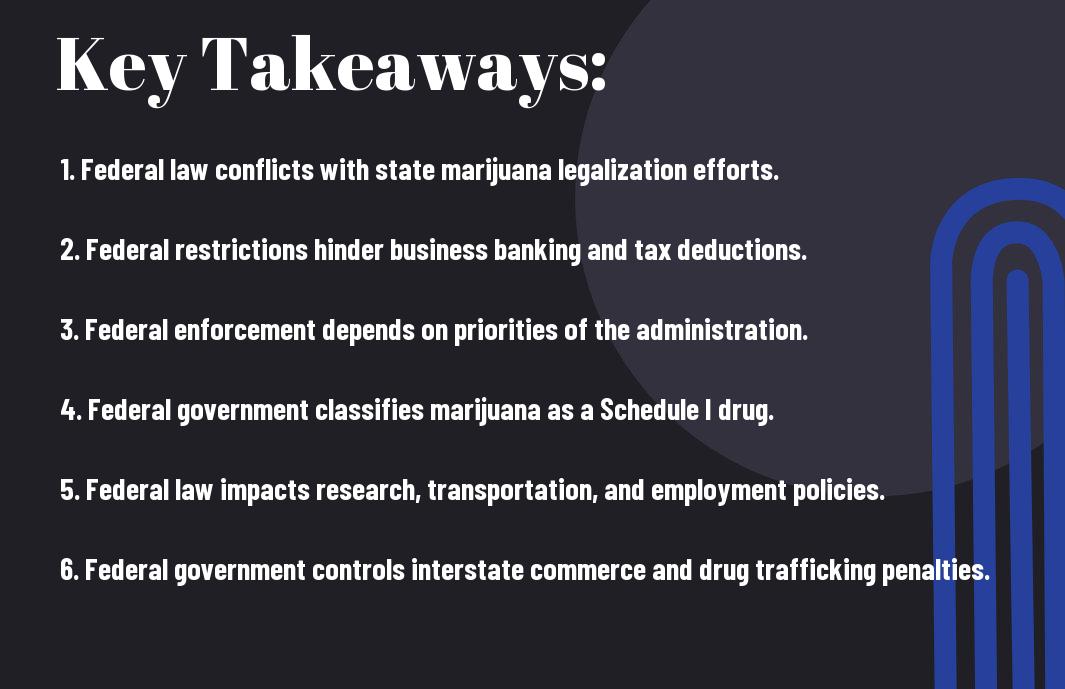
Key Takeaways:
- Federal law conflict: The conflict between federal and state laws regarding marijuana creates challenges and uncertainties for individuals and businesses operating in the cannabis industry.
- Federal enforcement discretion: The federal government has generally adopted a policy of enforcement discretion when it comes to prosecuting individuals and businesses complying with state marijuana laws.
- Impacts on banking: Federal laws, such as the Controlled Substances Act, create obstacles for marijuana businesses to access banking services and financial institutions due to concerns over money laundering.
- Tax implications: Marijuana businesses face unique tax challenges as they are subject to Section 280E of the Internal Revenue Code, which limits their ability to deduct business expenses on their federal tax returns.
- Potential for federal legalization: There is ongoing debate and efforts at the federal level to reform marijuana laws, including possible legalization or decriminalization, which could significantly impact the legal landscape for marijuana businesses.
Federal Legal Framework
History of Marijuana Regulation
Even before the modern era of marijuana legalization in various states, the federal government has had a long history of regulating the plant. The Marihuana Tax Act of 1937 was the first federal law that effectively banned marijuana. This was followed by the Controlled Substances Act in 1970, which classified marijuana as a Schedule I drug, alongside substances like heroin and LSD.
The Controlled Substances Act (CSA) and Marijuana
Federal law regarding marijuana is primarily governed by the Controlled Substances Act (CSA). This comprehensive statute provides the legal framework for the regulation of various drugs and substances in the United States. Marijuana’s classification as a Schedule I substance under the CSA means that it is considered to have a high potential for abuse, no accepted medical use, and a lack of accepted safety for use under medical supervision.
Another important aspect of the CSA is that it places marijuana under the jurisdiction of the Drug Enforcement Administration (DEA), a federal law enforcement agency responsible for enforcing the controlled substances laws and regulations in the country. This means that regardless of state laws legalizing marijuana for medical or recreational use, the DEA continues to have authority to enforce federal prohibition of the substance.
State-Level Marijuana Legalization
The Spread of Medical and Recreational Marijuana Laws
Now, let’s research into the evolving landscape of state-level marijuana legalization. The movement towards legalizing marijuana began with the passage of medical marijuana laws in California back in 1996. Since then, a growing number of states have followed suit, legalizing both medical and recreational use of marijuana. As of 2021, over 30 states have legalized medical marijuana, while 18 states and Washington D.C. have also legalized recreational use.
Conflicts Between State and Federal Law
An inherent challenge in the marijuana legalization landscape is the variance between state and federal laws. While states have the authority to create their own marijuana policies, the federal government still classifies marijuana as a Schedule I controlled substance under the Controlled Substances Act. This conflict has created a complex legal environment where businesses and individuals in compliance with state laws may still face potential federal prosecution.
Another point of contention arises in instances where federal law enforcement agencies may choose to intervene in states where marijuana is legal. This has resulted in confusion and uncertainty for businesses operating within the marijuana industry, as they navigate conflicting sets of laws and regulations from both state and federal authorities.
Impact of Federal Law on State Legalization
Keep a summary of pending federal cannabis legislation to understand the evolving landscape of marijuana legalization in the United States.
Federal Enforcement Priorities
One key factor impacting the changing marijuana legal landscape is the federal enforcement priorities. While states have been progressively legalizing marijuana for medical and recreational use, federal law still designates cannabis as a Schedule I controlled substance. The Department of Justice has issued guidelines prioritizing enforcement actions, focusing on areas such as preventing distribution to minors, combating drug trafficking, and addressing public health and safety concerns.
Financial and Banking Implications for Marijuana Businesses
The financial and banking implications for marijuana businesses are significant due to the federal prohibition on cannabis. Many financial institutions are hesitant to provide services to marijuana-related businesses due to the conflict between state and federal laws. This can lead to cash-only operations, limited access to banking services, and challenges in processing transactions, creating hurdles for businesses in the industry.
Banking solutions such as credit card processing, loans, and traditional banking services are often unavailable to marijuana businesses, forcing them to rely on alternative financial methods. The lack of access to banking services also raises concerns about transparency, regulatory compliance, and financial stability within the industry.

The Role of the Judiciary and Potential Legal Challenges
Federal Court Rulings on Marijuana
Legal interpretation of federal marijuana laws varies across different circuit courts in the United States. While some courts have upheld the federal prohibition on marijuana, others have ruled in favor of states’ rights to legalize and regulate the substance. The conflicting opinions among federal courts have created a complex legal landscape surrounding marijuana.
Implications of Legal Precedent and the Supremacy Clause
With the Supremacy Clause of the U.S. Constitution establishing federal law as the supreme law of the land, conflicts between federal and state marijuana laws can arise. Legal precedent set by previous court rulings plays a crucial role in shaping the framework for how these conflicts are resolved. The interpretation of the Supremacy Clause by the judiciary significantly impacts the legal landscape surrounding marijuana.
Plus, the way in which federal courts handle cases involving marijuana can set important precedents for future legal challenges. Decisions made by higher courts can have far-reaching implications for the enforcement and interpretation of marijuana laws at both the federal and state levels.
Policy Considerations and Legislative Reforms
Calls for Federal Policy Change
Change is constant in the marijuana legal landscape, and there are ongoing calls for federal policy reform. Recent Developments in Marijuana Law – CRS Reports highlight the complex nature of this issue, underscoring the need for thoughtful consideration of federal intervention. As more states legalize marijuana for medical and recreational use, there is a growing disparity between state and federal laws, creating a need for cohesive federal regulatory action.
Emerging Legislation and its Potential Impact
Calls for federal policy change have spurred the introduction of new legislation aimed at addressing the changing marijuana legal landscape. Emerging bills such as the SAFE Banking Act and the MORE Act seek to create a framework for federal regulation of marijuana, addressing issues such as banking access and criminal justice reform. Plus, these legislative proposals could potentially provide clarity for businesses operating in the cannabis industry and establish guidelines for ensuring public health and safety.
For more information on recent developments in marijuana law, refer to Recent Developments in Marijuana Law – CRS Reports.
Summing up
So, as we have explored, federal law plays a critical role in shaping the rapidly evolving landscape of marijuana legalization in the United States. The conflict between federal and state laws creates uncertainty for businesses and individuals navigating this space. While federal law continues to classify marijuana as a Schedule I controlled substance, recent shifts in enforcement priorities and legislative proposals highlight the potential for change at the federal level. It is imperative to stay informed and compliant with both federal and state laws to successfully navigate the complex legal landscape surrounding marijuana.
FAQ
Q: What is the impact of federal law on the changing marijuana legal landscape?
A: Federal law plays a significant role in the evolving marijuana legal landscape. While the federal government still classifies marijuana as a Schedule I controlled substance, many states have passed laws legalizing its use for medical and/or recreational purposes. This conflict between federal and state laws creates a complex legal environment that impacts businesses, consumers, and law enforcement.
Q: How does federal law affect marijuana businesses operating in states where it is legal?
A: Marijuana businesses operating in states where it is legal face numerous challenges due to federal law. These challenges include limited access to banking services, difficulties obtaining federal tax deductions, and the risk of federal prosecution despite compliance with state laws. Additionally, federal regulations impact licensing, interstate commerce, and product testing standards for marijuana businesses.
Q: Can federal law change to better align with state marijuana laws?
A: Yes, federal law has the potential to change to better align with state marijuana laws. Efforts are underway at the federal level to reform marijuana laws, such as proposed legislation to deschedule marijuana or provide states with more autonomy to regulate it. As public opinion shifts and more states legalize marijuana, there is growing momentum for federal changes that could create a more consistent and harmonized legal landscape for marijuana regulation.