
Marijuana Surveys conducted by various organizations explore deep into understanding the usage patterns and attitudes towards marijuana. These surveys are designed to gather data on factors such as frequency of use, methods of consumption, reasons for use, and perception of risks associated with marijuana. Organizations like the National Institute on Drug Abuse (NIDA) and the Substance Abuse and Mental Health Services Administration (SAMHSA) utilize different survey methods such as self-reported questionnaires, interviews, and data analysis to study trends and changes in marijuana usage and attitudes over time. By examining these research approaches, we can gain valuable insights into the complex landscape of marijuana consumption and public opinion.
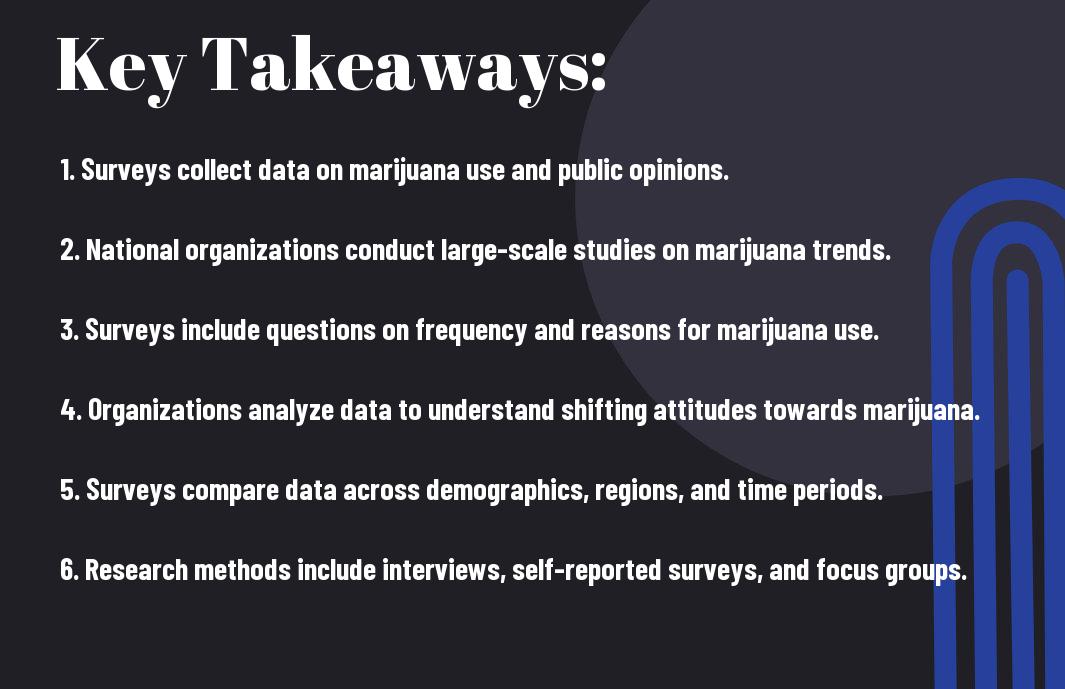
Key Takeaways:
- National Surveys: Organizations like the National Institute on Drug Abuse (NIDA) and the Substance Abuse and Mental Health Services Administration (SAMHSA) conduct national surveys to study marijuana usage and attitudes.
- Monitoring the Future: The Monitoring the Future survey focuses on studying substance use trends among 8th, 10th, and 12th graders, including marijuana use.
- State-Specific Surveys: Some states conduct surveys to collect data on marijuana usage and attitudes within their state, providing a more localized perspective.
- Surveys for Policy Evaluation: Surveys are also used to evaluate the impact of marijuana-related policies and regulations on usage patterns and public opinions.
- Longitudinal Studies: Longitudinal studies track individuals over an extended period to understand changes in marijuana usage and attitudes, providing valuable insights into trends and patterns.
Survey Methods for Studying Marijuana Usage
Cross-Sectional Surveys
There’s a common method used in studying marijuana usage called cross-sectional surveys. This involves collecting data at one specific time by surveying a large sample of individuals from various demographics. Researchers use this method to gather insights into the prevalence of marijuana use, attitudes toward its legalization, and other related factors.
Longitudinal Studies
Longitudinal studies, however, track the same group of individuals over an extended period. This method allows researchers to observe changes in marijuana usage patterns, attitudes, and behaviors over time. By following the same participants, researchers can identify trends, causality, and the long-term effects of marijuana use.
It is important to note that longitudinal studies require a significant investment of time and resources but provide valuable insights into how marijuana usage evolves within a specific population.
Types of Organizations Involved in Marijuana Research
All research related to marijuana, whether it concerns usage, attitudes, or health impacts, is conducted by a variety of organizations. These organizations play a crucial role in providing insights into the complex landscape of marijuana consumption. Each entity brings a unique perspective and methodology, contributing to a more comprehensive understanding of this topic.
| Governmental Agencies | Academic and Research Institutions |
| Non-Governmental Organizations (NGOs) |
Governmental Agencies
Any discussion on marijuana research would be incomplete without acknowledging the significant contributions of governmental agencies. These organizations, such as the National Institute on Drug Abuse (NIDA) and the Substance Abuse and Mental Health Services Administration (SAMHSA), fund and conduct crucial studies that shape public policy and health guidelines related to marijuana use and attitudes.
Academic and Research Institutions
On the other hand, academic and research institutions also play a pivotal role in studying marijuana usage and attitudes. For instance, research published in the Journal of Medical Internet Research explored the use of social media platforms like Facebook to examine cannabis use behaviors. This innovative approach offers new insights into understanding patterns of marijuana consumption among different demographic groups.
Non-Governmental Organizations (NGOs)
Non-Governmental Organizations (NGOs) also contribute significantly to marijuana research. These organizations, such as the Drug Policy Alliance and the Marijuana Policy Project, focus on advocacy, education, and research initiatives related to marijuana use. Their work often complements and challenges the findings of governmental agencies and academic institutions, providing a well-rounded perspective on marijuana.
Data Collection and Analysis Techniques
Questionnaire Design
Many surveys and organizations carefully design questionnaires to gather specific information to study marijuana usage and attitudes effectively. The questionnaire design process involves formulating clear and unbiased questions, ensuring the scope of inquiries aligns with the research objectives, and considering the target demographic’s language and cultural nuances. By employing validated survey instruments, researchers increase the reliability and validity of the data collected.
Statistical Methods for Analyzing Survey Data
Statistical methods are employed to analyze survey results to derive meaningful insights from the collected data. Standard techniques include descriptive statistics to summarize key findings, inferential statistics to make predictions and generalizations, correlation analysis to identify relationships between variables, and regression analysis to assess the impact of various factors on attitudes toward marijuana. Using these statistical tools, researchers can uncover patterns, trends, and associations within the data, leading to comprehensive interpretations.
The collection of diverse data sets across various demographics and regions helps provide a holistic view of marijuana usage and attitudes. By incorporating advanced statistical methods and a comprehensive questionnaire design, researchers can extract valuable insights and draw informed conclusions, contributing to the evolving understanding of marijuana trends and public opinions.
Ethical Considerations and Challenges
Privacy and Confidentiality
With the increasing focus on studying marijuana usage and attitudes, ensuring participant privacy and confidentiality is paramount. Organizations conducting surveys, such as the Preventing Youth Marijuana Use: National Survey Measures, must implement strict protocols to protect the identity of respondents. This includes data encryption, secure storage, and anonymous reporting to safeguard sensitive information and encourage honest responses.
Bias and Accuracy in Reporting
On the path to understanding marijuana usage, researchers must be vigilant about potential biases that could skew survey results. Biases can arise from social desirability, recall inaccuracies, or sample selection and impact the accuracy of findings. Organizations can mitigate bias and enhance the reliability of their research outcomes by utilizing diverse sampling methods, employing validated measurement tools, and conducting thorough data analysis.
Challenges may arise in addressing bias and ensuring accuracy in reporting marijuana usage data. Researchers must navigate cultural stigmas, legal complexities, and varying levels of disclosure among participants. Additionally, interpreting self-reported information requires a nuanced approach to capture the true extent of marijuana usage and attitudes within different populations. By confronting these challenges head-on and implementing ethical standards, organizations can contribute valuable insights to the discourse on marijuana use.
Impact and Applications of Research Findings
Policy Making and Legislation
Research findings on its impact heavily influence legislation around marijuana usage. Studies on usage patterns, health effects, and public attitudes help policymakers make informed decisions when creating regulations and laws regarding marijuana. Research findings play a crucial role in shaping the legal landscape surrounding marijuana, influencing everything from legalization efforts to the implementation of taxation and distribution frameworks.
Public Health Strategies
Research on marijuana usage and attitudes also informs public health strategies aimed at addressing potential risks associated with its use. Studies on the health effects of marijuana help public health officials develop targeted interventions, prevention programs, and educational campaigns to promote responsible use and minimize harm. By utilizing research findings, public health strategies can effectively address issues such as substance abuse, mental health implications, and youth prevention initiatives.
Understanding the impact of research findings on policymaking and public health strategies is necessary for addressing the complex challenges associated with marijuana usage. By leveraging scientific evidence and data-driven insights, stakeholders can develop more effective interventions, regulations, and educational campaigns to promote safe and responsible marijuana use within communities.
Final Words
Upon reflecting on how various surveys and organizations study marijuana usage and attitudes, it is clear that there are multiple methods and approaches utilized to gather data on this topic. From national surveys like the NSDUH to organizations like NORML and the Pew Research Center, each plays a crucial role in understanding the shifting landscape of marijuana use and public opinion. By combining quantitative and qualitative research methods, these entities provide valuable insights into trends, behaviors, and attitudes surrounding marijuana. As marijuana legalization continues to evolve, it is crucial to rely on these reputable sources to inform policy decisions, public health initiatives, and educational campaigns regarding cannabis use.
FAQ
Q: How do various surveys and organizations study marijuana usage and attitudes?
A: Various surveys and organizations study marijuana usage and attitudes through various methodologies, including but not limited to national surveys, research studies, focus groups, and interviews. These methods help gather data on patterns of use, attitudes toward legalization, perceptions of risk, and demographic information.
Q: What are some common questions asked in surveys about marijuana usage and attitudes?
A: Common questions asked in surveys about marijuana usage and attitudes include frequency of use, reasons for use, methods of consumption, perceived benefits and risks, attitudes towards legalization, sources of information, and demographics such as age, gender, education level, and income.
Q: How do organizations ensure the reliability and validity of data collected on marijuana usage and attitudes?
A: Organizations ensure the reliability and validity of data collected on marijuana usage and attitudes by using standardized survey instruments, sampling techniques representative of the population, ensuring participant confidentiality, employing trained researchers, conducting pilot studies, and using statistical analyses to detect and correct for biases.